
Carbon fiber has become one of the most widely used materials in sectors where the combination of mechanical strength and low weight is essential, such as automotive, aerospace and the manufacturing of composite materials.
However, the complexity of its surface and the nature of the weave can make it difficult to detect small irregularities, contamination or defects through conventional visual inspection.
At NUTAI, we work with machine vision technologies and high-resolution image acquisition systems to analyze complex materials such as carbon fiber and obtain objective information that supports industrial quality control processes.
For this type of application, NUTAI has linear and surface acquisition technologies that make it possible to evaluate the visible information on the material surface, adapting the system configuration to the characteristics of each sample and the required inspection criteria.
Evaluation of an automotive application sample
During tests carried out on a carbon fiber sample for an automotive application, we obtained an image acquisition that made it possible to clearly visualize an element that was difficult to detect through conventional observation: a human hair accidentally deposited on the surface.
Although this is an anecdotal case, the test helps illustrate the level of detail that can be achieved when working with high-resolution acquisition systems.
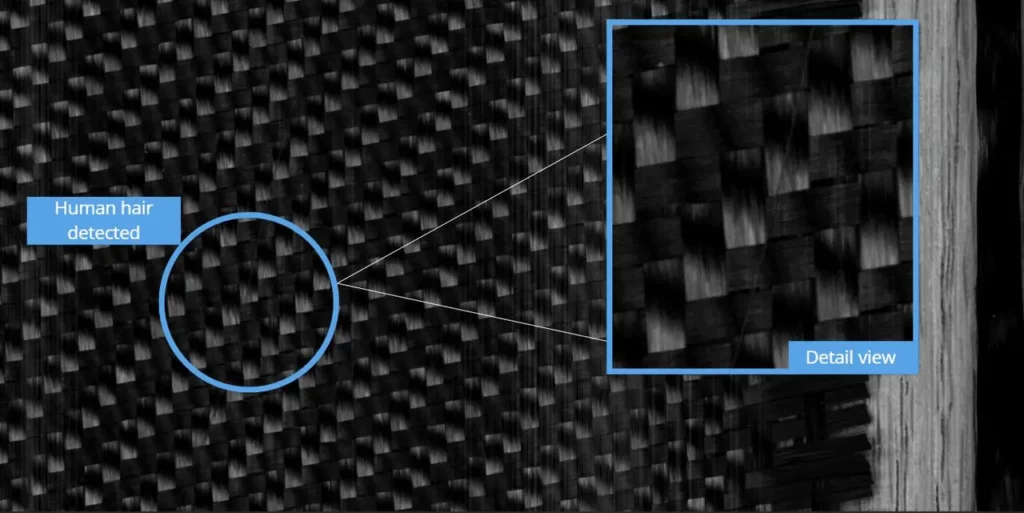
Beyond the example shown, this type of technology makes it possible to analyze surface characteristics of complex materials and identify elements that may affect the final quality of the product, including:
- Raised fibers
- Surface pores
- Surface contamination
- Scratches
- Marks
- Weave irregularities
- Finish variations
Example of a carbon fiber sample acquisition showing only the material surface information
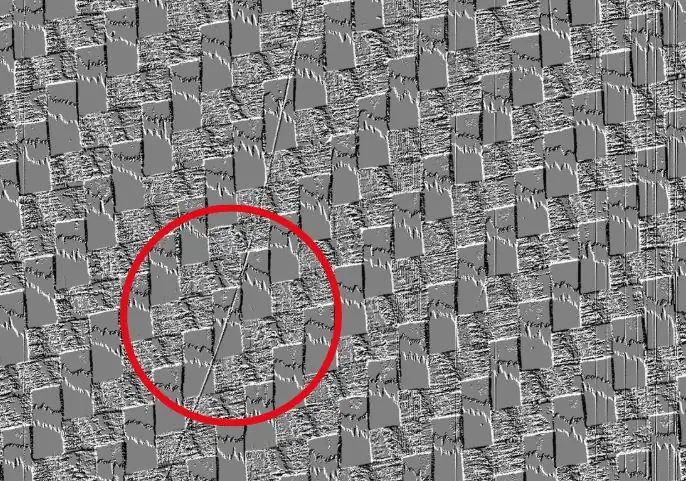
To put the level of detail obtained during the test into context, a human hair usually has a diameter of between 60 and 140 microns.
The acquisition reached an approximate resolution of 28 microns per pixel, equivalent to around 900 dpi, making it possible to visualize very small elements on a dark and structurally complex surface such as carbon fiber.
Machine vision for quality control of complex materials
Automating inspection processes makes it possible to apply objective and repeatable criteria when evaluating industrial surfaces.
In applications where surface quality is critical, machine vision systems can complement or replace certain manual inspection tasks, improving detection capability and process traceability.
If you manufacture carbon fiber components, composite materials or technical fabrics and want to evaluate new possibilities for industrial inspection, we can help you analyze your application.
Do you need to evaluate an industrial inspection application?
At NUTAI, we develop machine vision solutions adapted to industrial applications where it is necessary to analyze complex surfaces, detect irregularities or validate quality criteria on real samples.
If your company needs to evaluate defects, contamination or surface characteristics in composite materials, we can study the technical feasibility of the application and define the most suitable acquisition system.


